


Everyone has a theory about why match-3 is dying.
The genre is saturated. Players are bored. The mechanics are solved. Candy Crush peaked in 2014 and nothing has come close since.
Dream Games read none of those reports.
In February 2021 they launched Royal Match. No IP. No franchise. No sequel to an existing hit.
A clean-room match-3 built by a Turkish studio that had not shipped a major title before. By the end of 2024, Royal Match had generated $1.46 billion in revenue. By March 2026, it was running at more than $100 million a month.
This is not a story about a genre that survived. It is a story about what happens when one company refuses to accept the category consensus and executes better than the decade-long incumbent.
The Numbers Nobody Expected
The growth trajectory for Royal Match is almost without precedent in casual gaming:
2021: $172M
2022: $428M
2023: $851M
2024: $1.46B
All figures: Sensor Tower estimates. Dream Games is a private company and does not publish financials.
For context: in July 2023, Royal Match overtook Candy Crush Saga’s monthly revenue for the first time. Candy Crush had held the #1 position in match-3 for over a decade. Dream Games closed that gap in under three years from launch.
By 2024, Royal Match was out-earning Candy Crush by an estimated $500M annually. A single studio, a single game, four years.
In 2025, the trajectory shifted slightly. Sensor Tower estimates Royal Match at approximately $1.37B for the full year, still #1 in match-3, still top 5 globally, but the first annual dip since launch. We will come back to what that means.
What Most Analysis Gets Wrong
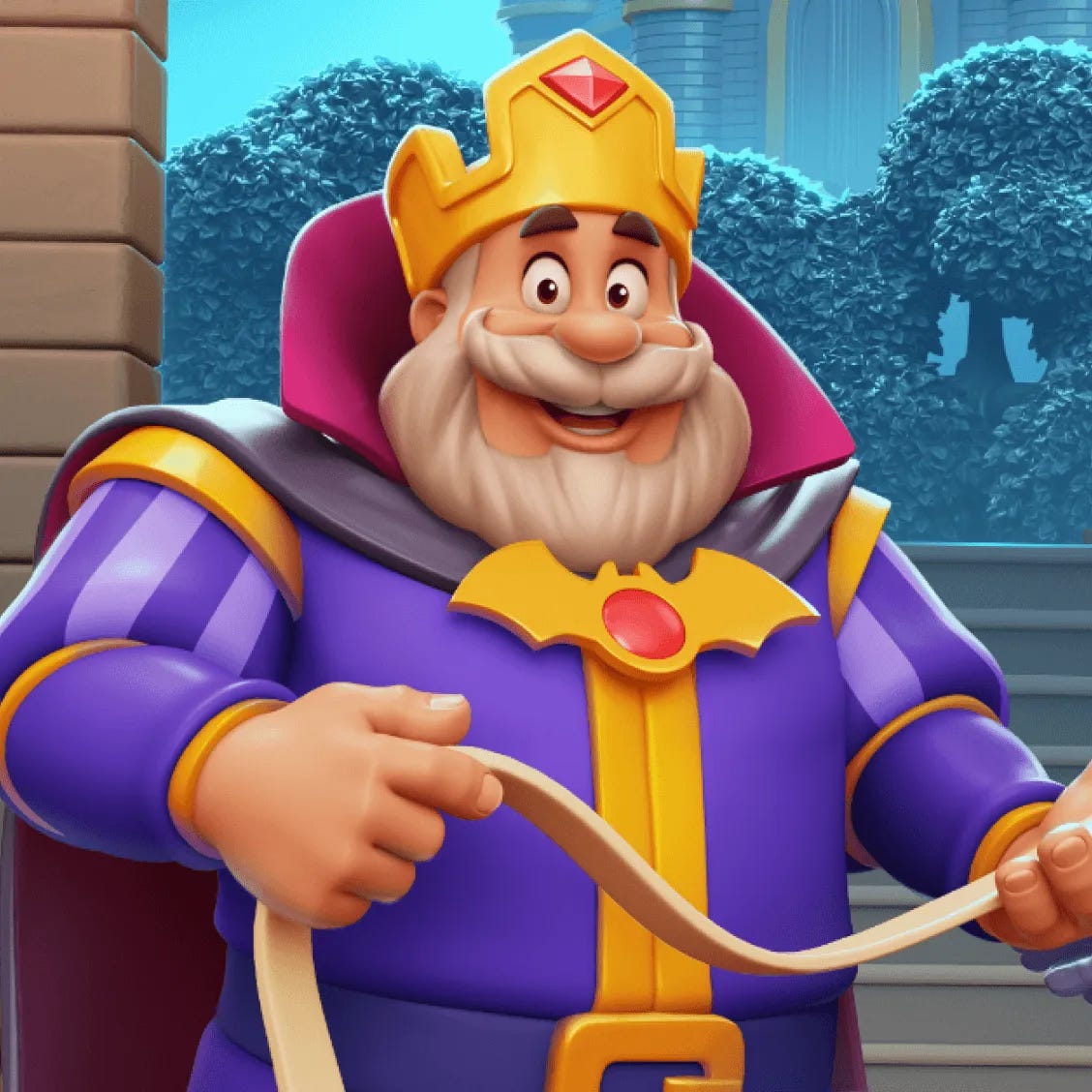
The standard narrative around Royal Match focuses on product. The mechanics are tight. The levels are well-designed. The meta layer, restoring King Robert’s castle, gives players a reason to keep progressing beyond the core loop. Live events drive engagement spikes. All true.
But product quality explains why players stay. It does not explain how they arrived.
Dream Games spent aggressively on user acquisition from the start. Not unusual for a mobile game. What is unusual is the scale they reached and the machine they built to sustain it.
At $100M+ per month in revenue, Dream Games is running one of the most sophisticated performance marketing operations in the world. They are active on Apple Search Ads, Meta, and AppLovin at significant scale. They have tested rewarded formats, interstitials, run creative at volume. The UA infrastructure that built Royal Match is not a department inside Dream Games. It is a competitive advantage in its own right.
Here is the part that should interest every UA manager reading this.
Dream Games does not own an ad network. They do not sit on the supply side of mobile advertising. They are entirely on the demand side — one of the largest single buyers of casual gaming inventory in the world.
When Dream Games is buying aggressively, CPIs in the puzzle and casual category go up for everyone around them. When they pull back, or when their LTV curves compress and they reduce payback targets, the entire UA economics of the category shift.
They are not a participant in mobile advertising. They are a price-setter.
The Monopoly Dynamic
This is the part that the “match-3 is dying” narrative gets completely backwards.
Match-3 is not dying. It has a monopolist.
When analysts say match-3 is saturated, what they are actually describing is the competitive landscape below Royal Match. There are hundreds of match-3 titles. Almost none of them are growing. Most are shrinking. A handful of mid-tier titles are surviving at steady state.
That is not saturation. That is consolidation. The revenue did not disappear from the genre. It concentrated in one game.
The evidence is in the data. Global casual gaming revenue has not collapsed. Royal Match’s trajectory shows a genre that is still monetising, but increasingly through a single point of capture.
Dream Games won the match-3 category the same way AppLovin is winning ad-tech: by out-executing the incumbents so decisively that the category reorganises around them.
The competitive implication is severe. Any new match-3 title is not competing for genre growth. It is competing for the fraction of players that Royal Match has not captured. Dream Games’ UA spend effectively makes that fraction more expensive to acquire. They are, in the most literal sense, pricing out the competition.
The 2025 Signal
The slight dip in 2025, from $1.46B to an estimated $1.37B, is worth examining carefully before dismissing it as noise.
There are three plausible explanations.
Seasonality and data variance. A 6% dip across a full year, given the variance in third-party estimates, may simply be within the margin of error. Dream Games does not publish actuals, so the comparison is estimate versus estimate.
LTV compression. Every game on a long growth trajectory eventually faces the problem of acquiring harder-to-retain users. The easiest players to acquire come first.
As Royal Match exhausted the high-LTV addressable audience in its top markets, the economics of each incremental user naturally soften. If this is the explanation, the 2025 dip is not a product problem. It is a scale problem , the inevitable consequence of reaching saturation in the premium cohorts.
Competitive pressure from the strategy category. 2024 and 2025 saw significant UA spend shift to games like Whiteout Survival, Last War: Survival, and Monopoly GO. These titles are competing for the same high-spending casual-adjacent audience that Royal Match monetises well. If Dream Games lost some of their best users to strategy titles, the revenue impact would show up in LTV, not in downloads.
The 2026 trajectory will tell us which explanation is correct. March 2026 at ~$102M annualises to approximately $1.2B which, if it holds, would confirm the dip is real rather than statistical noise.
What This Means for Publishers and UA Managers
If you are a casual or puzzle publisher: the ceiling question has been answered.
One studio proved the genre could sustain $1B+ annually from a single game.
If your match-3 or puzzle title is not at that scale, you are not competing with Royal Match. You are competing for what Royal Match left behind.
The addressable market is smaller than you think, and more expensive to reach than it was three years ago.
If you are a UA manager in mobile gaming: Dream Games’ UA spend is one of the biggest signals in the category. Track their creative volume on Meta and AppLovin’s ad libraries. When they are buying hard, the category is expensive. When they ease off, there is a window. They do not announce this. The signals are in the ad libraries and the CPI data from your MMP.
If you are an advertiser in mobile: Royal Match is the best case study in the industry for what execution-driven LTV expansion looks like at scale. Their funnel is not magic. It is repeatable. The question for every casual publisher is whether they are willing to invest in UA at the level Dream Games has, because that investment is now the cost of entry to the top tier.
The Bottom Line
Dream Games built a monopoly in match-3. They did it with one game, in four years, against a decade-long incumbent.
The result is a game generating over $100M a month in 2026, a UA machine that functions as a price-setter for casual gaming inventory, and a company that built one of mobile gaming’s most valuable businesses on the back of a single title.
The narrative that match-3 is dying was always wrong. The genre did not die. It just found its winner.
The harder question, the one the industry should be asking, is whether the 2025 revenue dip is the first sign that even Dream Games is not immune to the LTV math that eventually catches every hit.
We will find out in the next four quarters.
All revenue figures are Sensor Tower estimates. Dream Games is a private company and does not publish financials.