


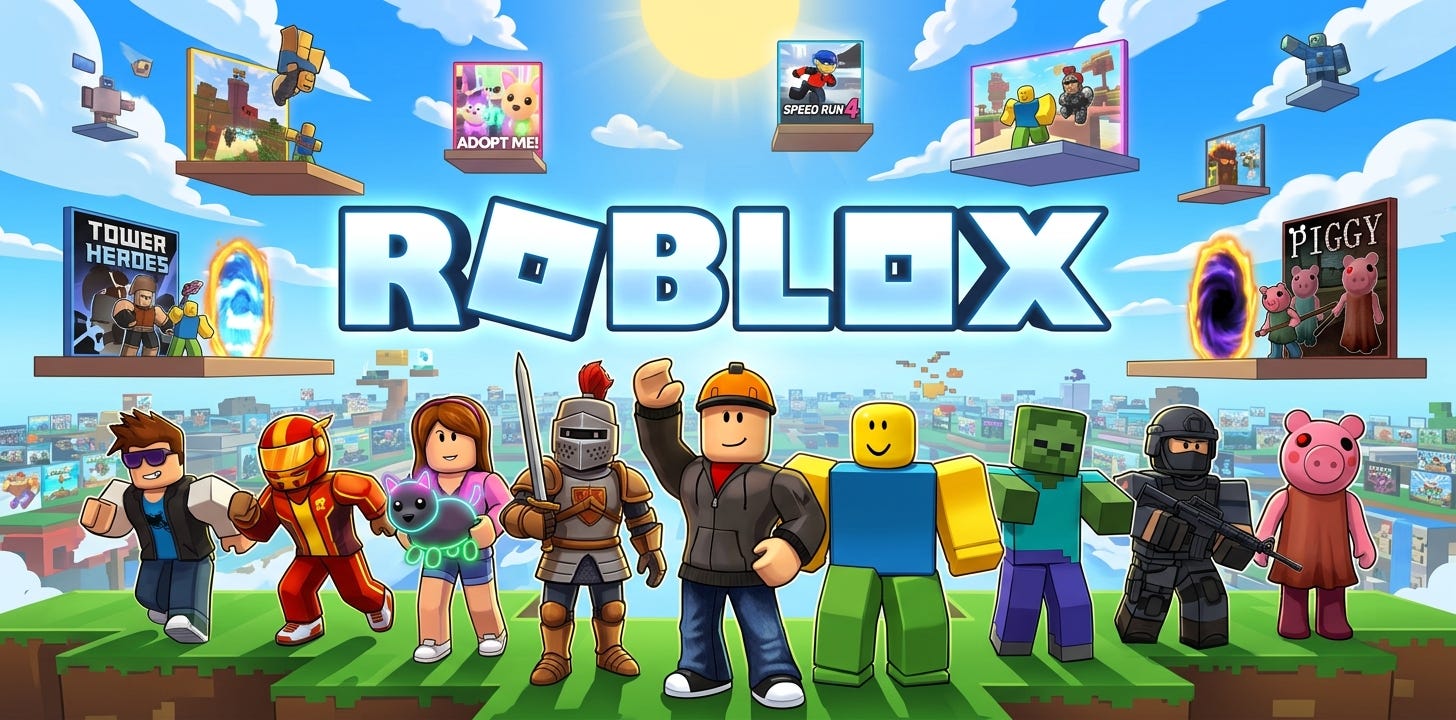
In the last seven days, Roblox made three announcements that the gaming press has largely covered as separate stories. A new subscription. Age-gated accounts. A requirement for developers to subscribe to reach younger users.
They aren’t separate stories. They’re one coordinated monetisation strategy and it tells you a lot about where platform economics are heading in 2026.
The numbers that made this inevitable
Start with the 2025 results.
Revenue hit $4.9 billion, up 36% year-on-year. Bookings, the better forward indicator, reached $6.8 billion, up 55%. Daily active users hit 144 million, up 69%.
For context, 144 million daily actives puts Roblox ahead of X (last reported DAU was around 100 million). It paid $1.5 billion to creators in 2025 alone. The top 10 developers averaged $33.9 million each, that’s up 450% since 2019.
At this scale, the growth playbook changes. You don’t need more users. You need more revenue per user, more revenue per developer, and more structural lock-in across the ecosystem. Everything Roblox announced this week serves exactly that goal.
Move 1: Roblox Plus — a retention mechanism dressed as a subscription
Roblox Plus launches April 30 at $4.99/month globally. On the surface it’s simple: subscribers get a 10% discount on in-game purchases, free unlimited private servers, and the ability to transfer Robux without transaction fees.
The mechanism worth understanding is the loyalty escalator. The discount doubles to 20% at month three of consecutive subscription. Cancel, and you drop back to zero. Restart, and the clock resets.
This isn’t Netflix-style passive retention. It’s an active penalty for leaving. The longer you stay, the more you lose by cancelling — which is a fundamentally different psychological contract than most subscriptions.
Roblox has been smart about the creator side too. They’re covering the discount themselves, meaning creators earn the same per-item as before. The subscriber’s Robux just stretches further, which in theory means more total purchases per subscriber. The platform absorbs the cost to avoid creator revolt while engineering higher spending frequency.
Retail partnerships with Samsung, Walmart, Amazon, and Target for bonus Robux offers also embed the subscription into purchasing behaviour that happens entirely outside the platform. That’s sophisticated distribution for a gaming product.
Move 2: Age-gated accounts — safety architecture with a monetisation layer
From June, Roblox rolls out two new account types for users under 16. Roblox Kids (ages 5-8) gets highly restricted content and no chat by default. Roblox Select (ages 9-15) gets a curated game catalogue and tighter parental controls. Accounts automatically progress as users age — Kids to Select at 9, Select to standard at 16.
The safety case is legitimate. Roblox says over half of its users are already age-checked. Unverified users will be pushed into a Kids-like experience — no chat, minimal content — until they complete verification. This is meaningful friction that most platforms have avoided because it creates drop-off risk.
The business logic running underneath it: by concentrating its youngest users into verified, age-gated tiers, Roblox creates a clearly defined, brand-safe audience segment. For advertisers, a verified 6-12 demographic with parental oversight is significantly more attractive than an anonymous mixed-age pool. Age-gating isn’t just compliance — it’s inventory quality.
Move 3: The developer requirement — where it gets interesting
This is the part most coverage has underplayed.
From May 19th, for a game to appear in front of users under 16, the developer must meet three requirements: ID verification, two-factor authentication, and an active Roblox Plus subscription.
Read that again. The $4.99/month subscription, launched as a player product on April 10th, becomes a mandatory operating cost for any developer who wants access to Roblox’s youngest and most active audience segment within six weeks of launch.
Roblox has been careful in how it frames this. The newsroom language says “developers must maintain an active Roblox Plus subscription” as one of several verification criteria. It doesn’t say “pay a monthly fee to publish.” But that’s the functional reality for any studio whose audience skews under 16, which is most of them.
For large studios generating millions in monthly revenue, $4.99 is noise. For the long tail of indie developers, educators, and smaller studios that Roblox has cultivated over a decade, it’s a new structural cost with no opt-out.
James Purell, founder of Roblox strategy consultancy BuildingBlox, flagged this in his LinkedIn breakdown: “The one thing I’ll note is the Roblox Plus requirement for developers. I think for younger developers, or those from more unfortunate regions, this does gatekeep development somewhat.”
He’s right. And Roblox knows it. The question is whether the quality improvement from filtering out unverified, low-investment developers outweighs the ecosystem cost of pricing some of them out.
The unified thesis
Roblox has built a two-sided platform tax.
Players pay $4.99/month to access discounts on spending they were already going to do. The longer they subscribe, the higher the switching cost.
Developers pay $4.99/month to reach the audience segment their games were built for. The subscription is framed as a verification and quality signal, but the economic reality is a recurring platform fee.
Both flows feed the same outcome: higher yield per user and per developer on a platform that’s already at 144 million daily actives.
This is the natural endpoint for any platform that reaches sufficient scale. The growth phase ends. The monetisation phase begins. Apple did it with the App Store. Google did it with Play. Meta did it with the news feed. Roblox is doing it with its creator economy.
The difference is that Roblox is doing it with considerably more transparency than its predecessors. The terms are published. The safety rationale is coherent. The creator economics have been designed to avoid the backlash that killed Unity’s runtime fee in 2023.
What this means for UA managers and publishers
If you’re running UA on Roblox or considering it, the age-gating changes your targeting options significantly. A verified under-16 audience is a different product than an open platform, higher quality signal, potentially higher CPMs, but narrower reach for titles that depend on the casual, mixed-age install base.
The developer subscription requirement also signals where Roblox wants its ecosystem to go. Verified, professional, subscription-paying developers building curated content for a known audience. That’s a more controlled environment for brand advertising.
The flywheel is changing shape. Same platform. Different economics.
───
Sources:
Revenue $4.9B, Bookings $6.8B, DAU 144M (Roblox Q4 2025 Shareholder Letter)
$1.5B paid to creators, top 10 dev earnings (Roblox Q4 2025 Shareholder Letter) Roblox Plus mechanics, April 30 launch (Roblox newsroom)
Age-gated accounts, June rollout (Roblox newsroom)
Developer Roblox Plus requirement (Roblox newsroom, age accounts page (evaluation criteria section))
Developer gatekeeping quote (James Purell, BuildingBlox LinkedIn post, April 2026)